MSF presentsAnnual national maths challenge
RecognisingRamanujan
A search for young minds who do not simply solve problems— they see numbers differently.
- For
- Grades 6–10
- Format
- Online challenge
- 2026 edition
- Registrations open
Entry 01Overview
What is Recognising Ramanujan?
An assessment initiative for school students that looks beyond conventional examinations to explore how they think mathematically.
What does it take to think mathematically? Not just formulas or right answers — but reasoning through a problem and finding a way forward when the solution isn’t obvious.
- Patterns
- Connections
- Reasoning
- Estimation
- Interpretation

Launched in
2019
Under the aegis of the Mathematical Sciences Foundation, inspired by Srinivasa Ramanujan’s remarkable journey.
Who can participate?
School students, currently at two levels.
Junior level
Standards 6 and 7
Senior level
Standards 8 to 10
Beyond the exam hall
Designed to find ability that conventional exams and coached preparation can miss — and to encourage curiosity, creativity and independent thought.
More than a competition
Feedback for students. Insight into mathematical learning for schools and education partners.
- Identifymathematical potential.
- Understandstrengths and learning needs.
- Nurturestudents through further chances to engage with maths.
By the numbers
The programme — and the mathematician behind it — at a glance.
- 2019Launched under MSF
- 2Levels: Junior & Senior
- 8Abilities we assess
- 1887–1920Ramanujan’s lifetime
- 1913His letter to G. H. Hardy
- 1918Fellow of the Royal Society, aged 30
- ≈3,900Results he compiled
- 22 DecNational Mathematics Day
Entry 02The programme
How does it work?
An online assessment built around mathematical reasoning and thinking, rather than syllabus mastery.
Conducted online
Reasoning over recall.
Unfamiliar problems reduce the advantage of rote preparation and coaching — and show how students really think.
- Accessible
- Scalable
- Simple to administer
Students are asked to…
- Reason logically
- Recognise patterns
- Interpret information
- Estimate
- Make connections
- Solve creatively
What’s in it for you?
For students · 4 reasons to take part
- Engaging, not stressfulMeet mathematical ideas in unfamiliar ways — something to explore, not just prepare for.
- Show how you thinkA chance to demonstrate how you approach problems you have not seen before.
- Know your strengthsFeedback on what you do well and where you can grow.
- Be recognisedExceptional promise can earn certificates, awards, mentoring and more.
For schools · 6 ways it helps
- Identify potentialFind students with particular strength in reasoning, problem-solving and pattern recognition.
- Understand learning needsAggregated results give a broader picture of strengths and areas needing attention.
- Support studentsPinpoint opportunities for remedial support, enrichment and continued engagement.
- Support teachersFindings can shape refreshers, workshops and orientation sessions.
- School & district insightsResults across a group of schools can be viewed school-wise or district-wide.
- Nurture high potentialMentoring, group projects and advanced activities for students who show exceptional promise.
Schools that encourage strong participation and mathematical excellence may also be recognised.
Entry 03What we assess
Looking beyond syllabus knowledge.
Eight qualities that underpin mathematical thinking — not how much of the curriculum a student can recall.
Logical reasoning
Can you use the information available to make connections and arrive at a conclusion?
Pattern recognition
Can you identify relationships, structures and patterns that may not be immediately obvious?
Estimation
Can you make sensible judgements about quantities, scale and approximate values?
Interpretation
Can you understand and make meaning from numerical, visual and other forms of information?
Analytical thinking
Can you break an unfamiliar problem into parts and work through it systematically?
Creative problem-solving
Can you explore different approaches rather than relying only on a familiar procedure?
Curiosity & independent thinking
Can you engage with a question when there is no immediately obvious way to solve it?
Precision in communication
Can you express your reasoning and ideas clearly and accurately?
Entry 04About Ramanujan
Srinivasa Ramanujan1887–1920

Little conventional training. Intense curiosity. A rare eye for patterns — and a letter that changed everything.
Born in Erode and raised in Kumbakonam, he developed much of his mathematics on his own. What makes his story remarkable is not simply that he became a great mathematician — it is how he got there.
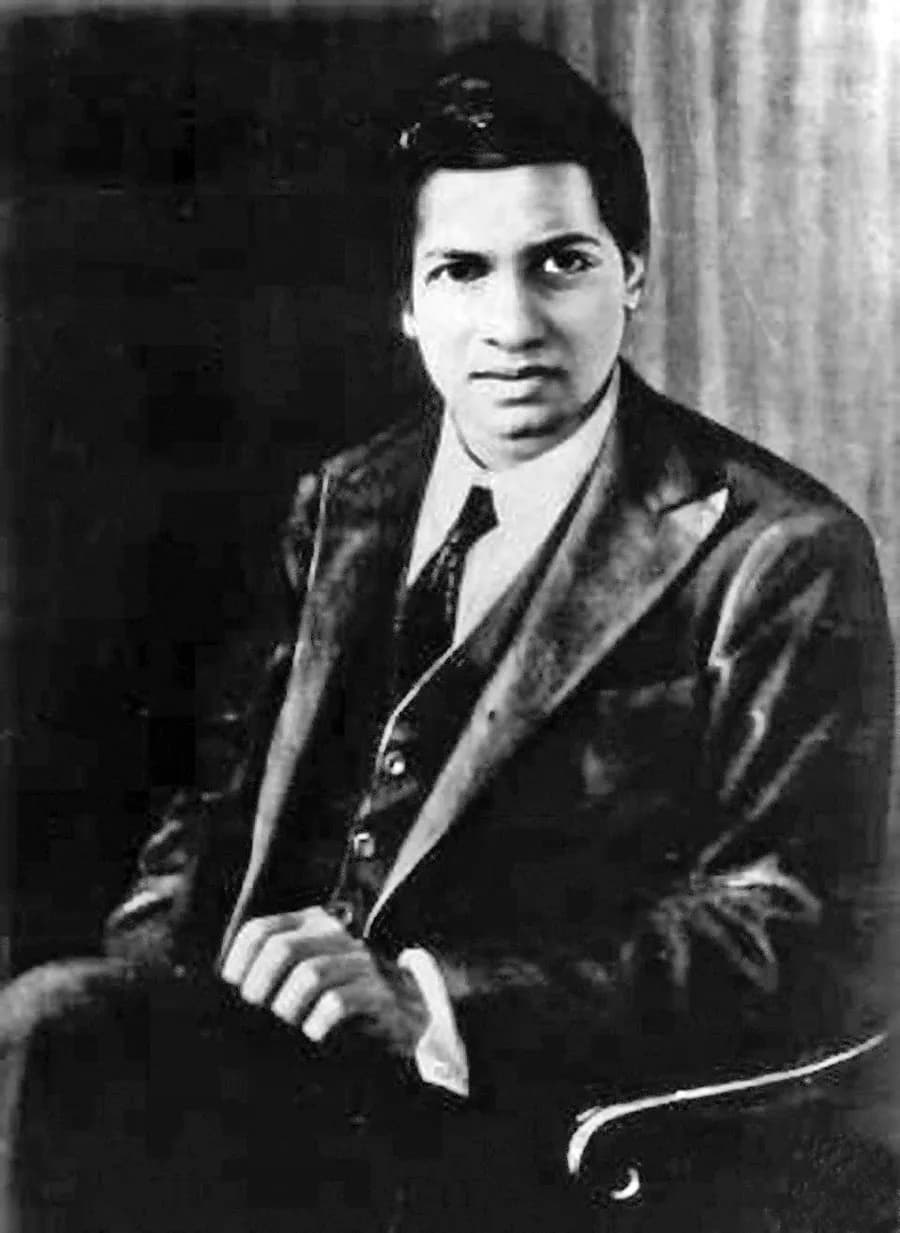
Pages from a life
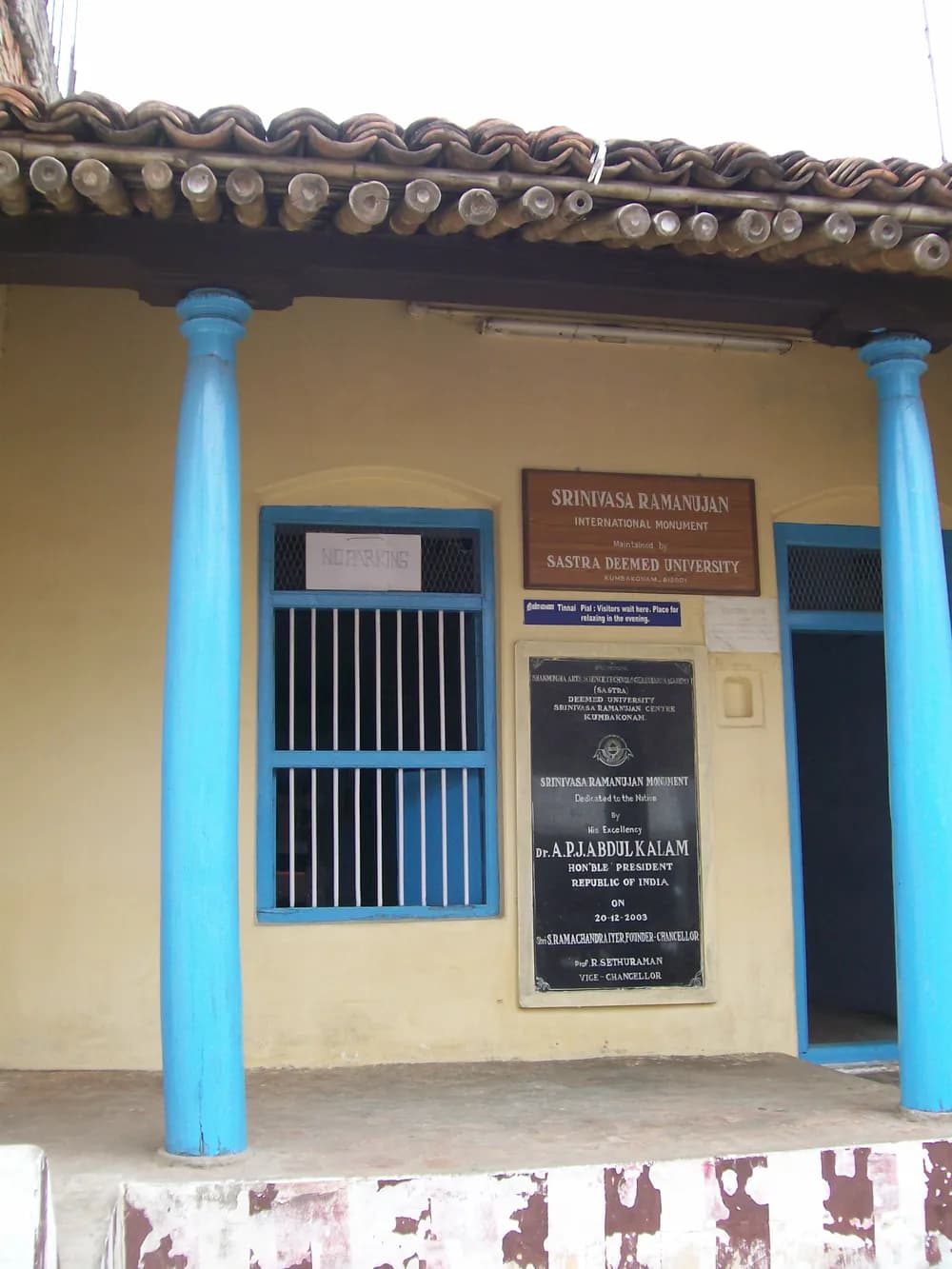
His home on Sarangapani Street, Kumbakonam — now a memorial. 1887
Erode
Born 22 December
In what is now Tamil Nadu. He grew up in Kumbakonam.
Age 12
Ahead of the syllabus
Had already mastered an advanced trigonometry book.
Age 17
Original research
Investigating Bernoulli numbers and the Euler–Mascheroni constant.
College
Didn’t fit the system
Lost a scholarship after not passing his non-mathematical coursework.
By day
Madras
A clerk at the Port Trust
On a modest salary — his evenings belonged to mathematics.
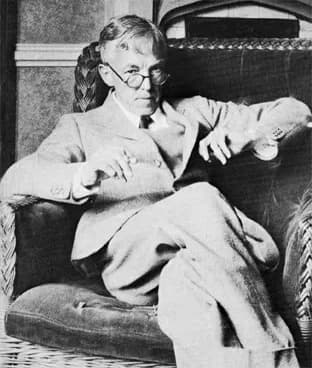
G. H. Hardy, c. 1927. 1913
Madras → Cambridge
The letter
Pages of results reached G. H. Hardy. He wondered if it was a hoax — then saw extraordinary originality.
1914
Cambridge
To England
With his mother’s consent, despite social and religious objections.
1918
Cambridge
Fellow of the Royal Society
And a Fellow of Trinity College, Cambridge — aged just 30.
1919
India
The return home
Back in India, in poor health, still working on mathematics.
1920
Kumbakonam
A short life
Died on 26 April, aged 32. His legacy has lasted far longer.
1914–19
Cambridge, at last
For the first time, he could devote himself almost entirely to mathematics — alongside professional mathematicians.
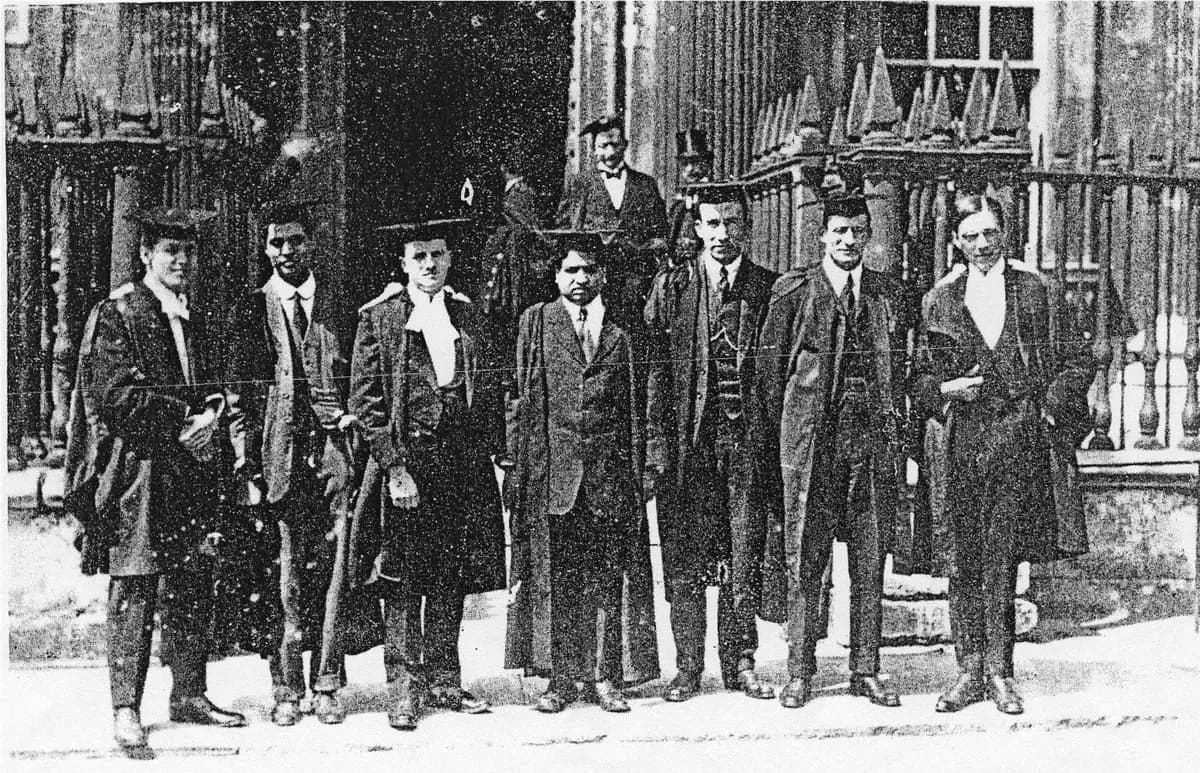
Rigour meets intuition
Hardy prized formal proof; Ramanujan reached results through extraordinary intuition. Their differences could be frustrating — and extraordinarily productive.
National Mathematics Day
India celebrates Ramanujan’s birthday, 22 December, every year.
The notebooks live on.
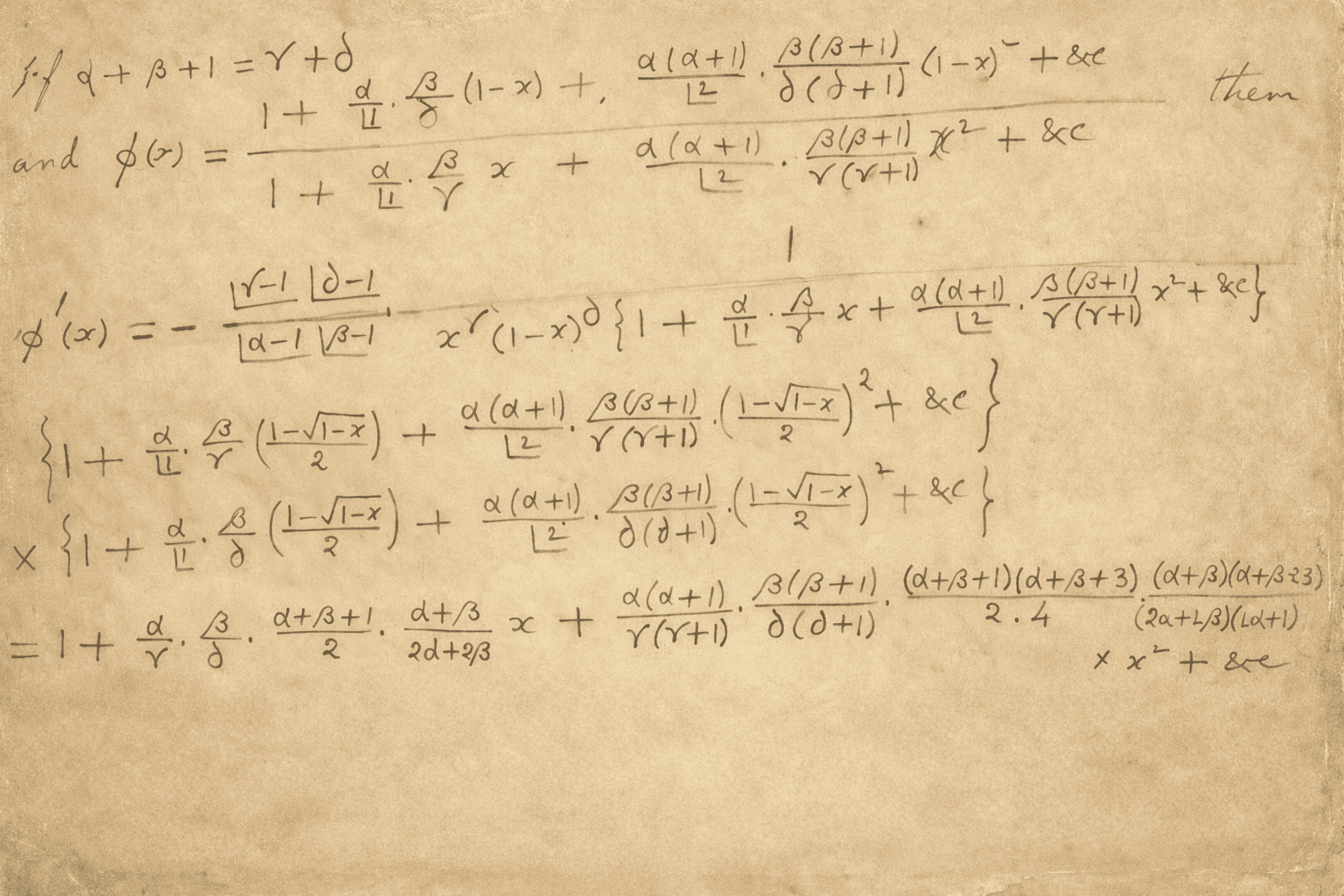
Thousands of formulas, often recorded without proofs. Some took mathematicians decades to prove — and his work still generates research today.
Where he left his mark
Associated with his name
≈3,900results compiled in one short life, mostly identities and equations, largely worked out on his own.
A mathematician who followed the mathematics wherever it led him.
Photographs: Wikimedia Commons, public domain.
Entry 05Student voices
In their own words.
What past participants said about taking part in Recognising Ramanujan.
On the paper
Paper was really entertaining.
Akshit GuptaDPS RohiniBudding Ramanujan 2019 On the maths
Maths part was just from the overall education that we got.
Mohammad Saad AnjumBlossoms School, AligarhBudding Ramanujan 2019 On preparing
We just had to study about the life of Ramanujan.
Moh BhargavaDPS RohiniBudding Ramanujan 2019
Entry 06Knowledge test
Think you know Ramanujan?
Take the 10-question challenge — then try to spot the myth.
Take the challenge- Questions
- 10
- Myth-busting bonus
- +1
Coming soonA look back at earlier editions.
Entry 07Register
Perhaps the next notebook is yours.
Registrations for Recognising Ramanujan 2026 are open to students in Standards 6–10.